
How MBER runs high-end Pan-Asian service on Dines
A sharing-plate restaurant where every dish has a build and every table has its own pace. The platform underneath has to keep up without ever getting in the way.
Robust POS system needed to match a demanding menu.
Dines was built for the most demanding rooms in hospitality: festival sites at peak throughput, West End theatres clearing a bar in a 15-minute interval, food halls settling dozens of vendors a night. MBER is none of those things.
MBER is a high-end Pan-Asian restaurant in London where the menu is built around sharing plates, complex flavours, and dishes assembled to order across multiple kitchen stations. The dining room runs across four zones: the Snug, the Retreat, the Cellar Bar, and the Main Bar. Each one has its own rhythm. The kitchen is doing serious work, and so is the floor. The two have to stay in lockstep through every service.
The same platform that holds up under festival peak has to hold up under the precision a room like MBER demands.
A high-end sharing-plate concept makes demands a generic POS system was not built for.
Bills are long and high-touch. The average MBER bill clears £200, built from more than ten dishes with frequent modifiers, dietary substitutions, and written-in special requests. More than one in three of those dishes is modified to the guest's spec: gluten-free swap, no shellfish, build to share. The kitchen has to read that complexity in real time. Coursing, allergen-flagged dishes, modifier swaps, pacing across stations: all of it has to land at the right pass at the right time.
The guest expects the team's attention to be on them, not on a screen. The platform behind the floor has to be fast, quiet, and reliable enough to disappear.
An end-to-end hospitality operating system built for complex F&B.
MBER runs Dines end to end: front of house, back of house, and the connective tissue between them.
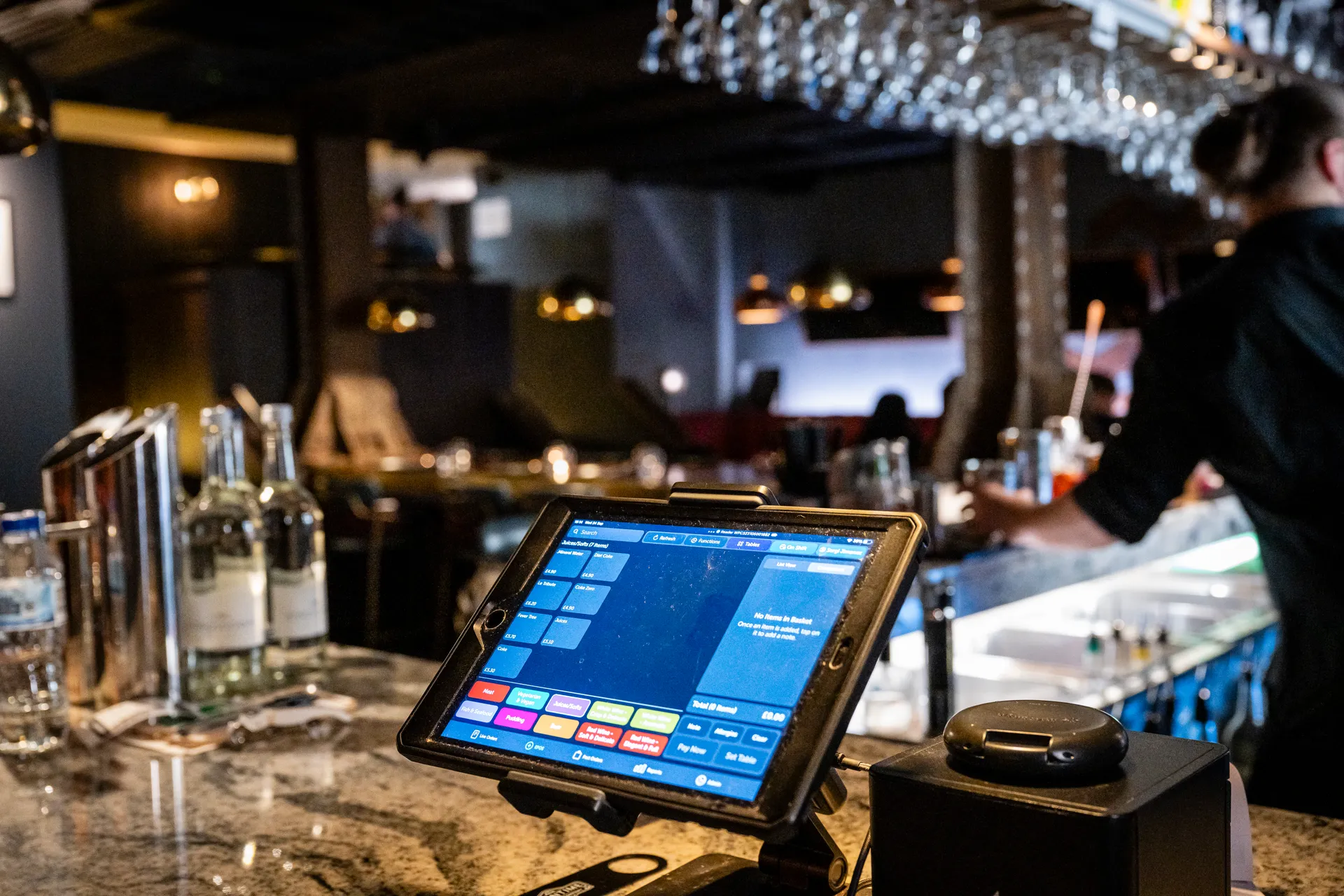
On the floor. Every server carries an iPad as a full point of sale. Orders go in at the table, modifiers are applied in seconds, and the bill stays open across the meal so courses can be added as the conversation evolves. The server is the relationship; the iPad just keeps up.
In the kitchen. Tickets fire to the right station at the right time. Each station sees only its own work, on its own printer, in the right sequence, so cold, hot, wok and pass are all preparing in parallel rather than waiting on the same paper. The Kitchen Display System sits over the top, holding the full picture: coursing, allergen flags, modifiers, pacing across the room. Dishes from multiple stations arrive at the pass together, the way a sharing-plate menu has to be served.
Through the menu. Dines' allergen and dietary tagging does heavy lifting at MBER. More than nine in ten bills touch at least one dish with a dietary or allergen tag, from gluten-free and dairy-free to vegan and alcohol-free. Tags are set once on each item and surface automatically the moment the dish is added to the bill. When a guest asks if something is gluten-free, the answer is on the iPad in front of the server, not in a folder behind the bar.
Across service. Bills run open across long, layered meals. Modifiers, written-in requests, and split payments are all handled on the same bill, so the server never has to break flow to reconcile.
Most tables here have at least one dietary requirement to handle. With Dines, the answer is on my iPad the moment I add the dish to a bill. I never have to leave the table to check with the kitchen, which means the team stays with the guest.
Conor Field, General Manager, MBER
Dines solves GM's major headaches
The point of all of this is what the guest does not see. They do not see the platform. They see a server who knows the menu, a kitchen that hits the pass on time, and a bill that arrives without drama at the end of a long meal.
What they do see is the room, the food, and a team focused on them. MBER is a destination for the meals that matter most: birthdays, anniversaries, business dinners that close deals, the table you booked weeks ahead. The technology is one part of getting that night right, the smaller part, but it is the part that cannot let the rest down.
When something does come up mid-service, the Dines support team responds in under 60 seconds with an average resolution time of around five minutes. A real person, while the room is still full. No tickets, no chatbots, no hold music.
In a restaurant operating at MBER's level, that matters as much as the platform itself.
Service in a busy restaurant can be gruelling. The system has to work, and it has to be there when something comes up. With Dines we get a real person on the other end in seconds, not a ticket. You feel that on the floor. The kind of restaurant we're trying to run only works if every part of it pulls its weight. Dines is the part of the operation we never have to think about. In this industry, that's the highest compliment I can give a piece of technology.
Nieves Sanchez Calvo, Duty Manager, MBER
Growing with Dines.
MBER and Dines continue to develop the operation together, with ongoing work on staff scheduling, rotas, and reporting that pull more of the floor and back-office picture into one view. The restaurant stays focused on the menu and the guest. The platform stays in the background, doing its job.